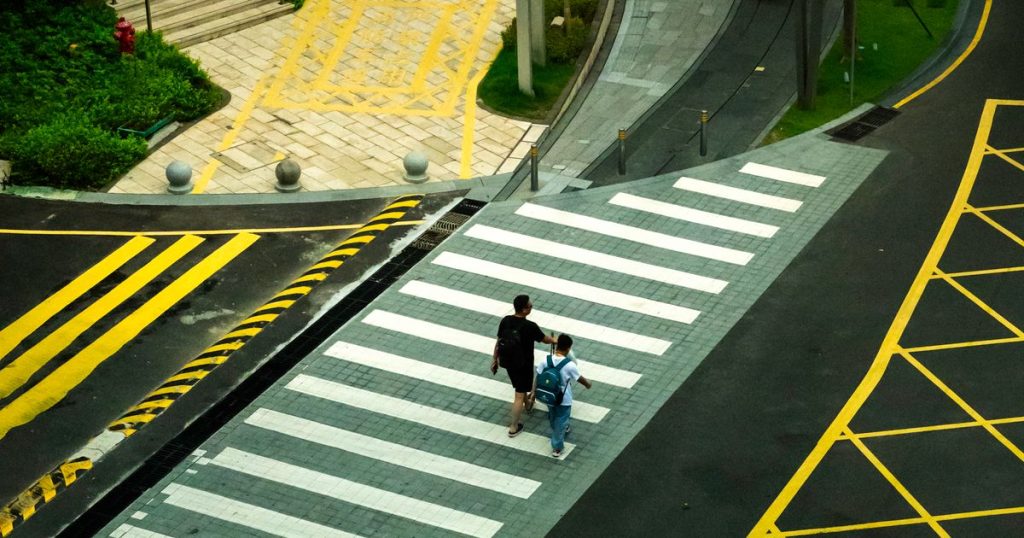
You were walking across a Los Angeles street, not in a crosswalk, and a car hit you. Now the driver’s insurance company says the crash was your fault. The short answer: crossing outside a crosswalk does not, by itself, end your injury claim in California. Fault can be shared, and the driver still had a duty to be careful.
This guide explains what changed under the Freedom to Walk Act, what the law still expects from walkers and drivers, and how shared fault works when a pedestrian is hit outside a crosswalk.
What the Freedom to Walk Act Changed in 2023
Assembly Bill 2147, known as the Freedom to Walk Act, took effect on January 1, 2023. It changed several pedestrian rules in the Vehicle Code, including section 21955, the rule against crossing between two signal-controlled intersections except in a crosswalk.
Under the new wording, a peace officer may not stop a pedestrian for that kind of crossing unless “a reasonably careful person would realize there is an immediate danger of a collision” with a moving vehicle or a device moving by human power, such as a bicycle. The same limit was added to other pedestrian sections, including section 21954, and to local anti-jaywalking ordinances through section 21961.
In plain words, the law mostly changed when police may stop and ticket a person for crossing. It did not erase anyone’s duty to be careful.
The Duty to Be Careful Still Applies to Both Sides
Each of these sections now says the same two things. The change “does not relieve a pedestrian from the duty of using due care for their safety.” It also “does not relieve a driver of a vehicle from the duty of exercising due care for the safety of any pedestrian within the roadway.”
So an insurer cannot simply say that a walker outside a crosswalk has no claim. A driver who was speeding, looking at a phone, or not watching the road may still be responsible. At the same time, a walker who stepped out in front of a close car may share the blame.
Who Has the Right of Way Outside a Crosswalk?
Section 21954 says a pedestrian crossing anywhere other than a marked crosswalk, or an unmarked crosswalk at an intersection, must yield to vehicles “so near as to constitute an immediate hazard.” The next part of the same section says this rule does not relieve the driver “from the duty to exercise due care for the safety of any pedestrian upon a roadway.”
Crosswalks work differently. Under section 21950, a driver must yield to a pedestrian crossing within a marked crosswalk or an unmarked crosswalk at an intersection. That same section says no pedestrian may suddenly leave a curb and walk or run into the path of a vehicle that is so close it is an immediate hazard.
This matters because many people think they were outside a crosswalk when they were not. An intersection can have an unmarked crosswalk even with no painted lines. Where you crossed should be checked carefully, not guessed.
How Shared Fault Works in California
California uses what courts call “pure” comparative negligence. In Li v. Yellow Cab Co. (1975) 13 Cal.3d 804, the California Supreme Court replaced the old all-or-nothing rule. Under the rule the Court adopted, liability is assigned “in direct proportion” to each person’s fault. That holds even when the injured person was equally at fault or more at fault than the other side.
The general duty of care comes from Civil Code section 1714. It makes everyone responsible for injuries caused by a lack of ordinary care, except to the extent the injured person brought the injury on themselves.
Here is what that means in practice. If a jury decides a driver was mostly at fault and the walker was partly at fault, the walker’s damages are reduced by the walker’s share. The claim is not thrown out just because the walker was partly to blame.
Why a Ticket, or No Ticket, Does Not Decide Your Claim
After the Freedom to Walk Act, a police report may show that no one was cited for crossing. That does not prove the walker did nothing wrong. A citation for the driver does not settle the case either. The rules in the Vehicle Code limit when officers may stop people. The injury claim is a separate question about who used reasonable care.
The report may be one of the first documents an insurer reads. If it has a mistake about where you crossed or what the light showed, that mistake can follow your claim. That is one reason to get the report and read it closely.
Steps to Take After a Pedestrian Crash in Los Angeles
- Get medical care and keep every record and bill.
- Get the crash report from the agency that responded. Our guide on how to get your CHP or LAPD crash report in Los Angeles explains the process.
- Photograph the place you crossed, including signals, painted lines, parked cars, and lighting.
- Write down the names and phone numbers of anyone who saw the crash.
- Ask nearby businesses whether a camera covered the street, since recordings may not be kept for long.
- Keep your own notes about what you saw and when, in your own words.
If the driver left the scene, our post on deadlines after a hit-and-run in Los Angeles covers claims under your own policy. If you are making a claim against the driver’s insurer, our guide to third-party claims after a California car crash explains how that process starts.
Common Questions From Pedestrians Hit by a Car
Is jaywalking legal in California now?
Not completely. The rules about where to cross are still in the Vehicle Code. What changed is that officers may stop a pedestrian for these crossings only when a reasonably careful person would see an immediate danger of a collision.
Can I still recover if I was partly at fault?
Under the pure comparative negligence rule from Li v. Yellow Cab Co., partial fault reduces damages instead of barring the claim. How fault is divided depends on the facts of each crash.
Does a driver have to watch for people outside crosswalks?
Yes. Sections 21954 and 21955 both say the pedestrian rules do not relieve a driver of the duty to use due care for the safety of pedestrians in the roadway.
When to Call Mines Law Firm
We handle auto accident injury claims, and are accepting clients for those. If you are injured in an auto accident, that is when you should call us at 888-700-0093.
ATTORNEY ADVERTISING. This article is for general information only and is not legal advice. Reading it does not create an attorney-client relationship. Every case depends on its own facts, and prior results do not guarantee a similar outcome. Responsible attorney: Jasmine Mines (State Bar No. 331135), Mines Law Firm, 468 N. Camden Drive, Suite 200, Beverly Hills, CA 90210.