
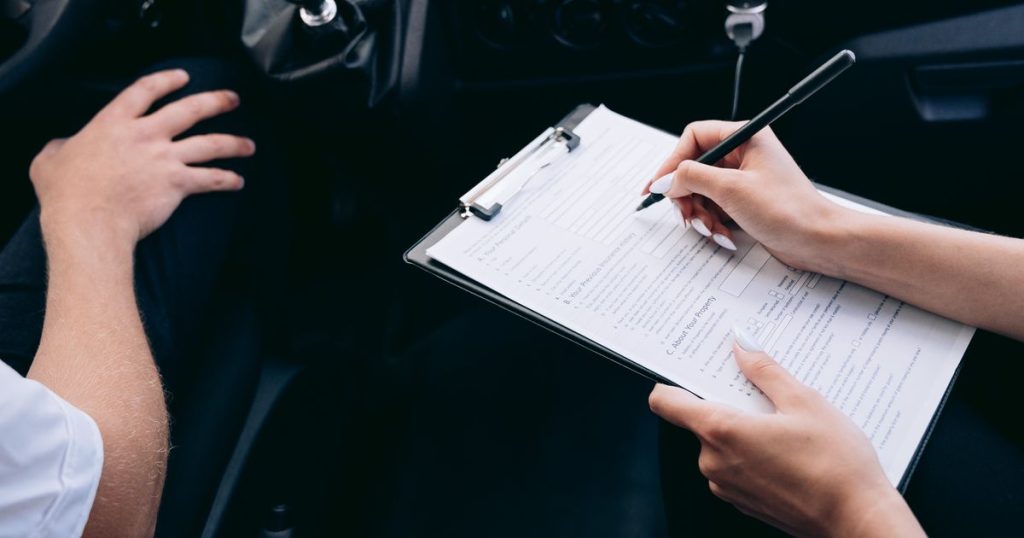
You were hurt in a crash in Los Angeles, an officer came to the scene, and now everyone keeps asking for “the report.” The short answer: if you were a driver, a passenger, an injured person, or a vehicle or property owner, California law gives you the right to a copy of the whole crash report. You request it from the agency that wrote it, usually the California Highway Patrol (CHP) or the Los Angeles Police Department (LAPD), and you pay a fee that the law caps at the actual cost of the copy.
Your Right to the Full Crash Report Comes From Vehicle Code Section 20012
Crash reports are not open to the general public. Under Vehicle Code section 20012, they are confidential, with one big exception. The CHP or the police agency that took the report must disclose “the entire contents” to any person with a proper interest.
The statute lists who that includes:
- The drivers involved, or a driver’s guardian, conservator, or authorized representative.
- The parent of a minor driver.
- Any named person injured in the crash.
- The owners of vehicles or property damaged in the crash.
- People who may face civil liability because of the crash.
- An attorney who declares under penalty of perjury that he or she represents one of those people.
The same section says the fee for a copy cannot be more than the actual cost of providing it. Check the agency’s current fee before you send payment.
First, Figure Out Which Agency Wrote Your Report
You have to ask the agency that investigated the crash. The CHP says plainly that it can only provide copies of collision reports it investigated. It cannot pull a report written by a city police department.
Crashes on Los Angeles freeways, such as the 405, the 110, or the 10, are typically handled by the CHP. Crashes on surface streets inside the City of Los Angeles are typically handled by the LAPD. Other cities in Los Angeles County may use their own police department or the Sheriff’s Department. A report number from the officer at the scene is the fastest clue. If you are not sure, the CHP suggests calling your local police department or any CHP office for help finding the right agency.
How to Request a CHP Crash Report
The CHP uses a form called the CHP 190, Application for Release of Information. According to the CHP’s collision report page, the steps are:
- Print and fill out the CHP 190, or write a personal letter with the same information.
- Give the collision date and location. If you do not know the exact date or place, the CHP asks for your best estimate and as much detail as you have.
- Check one box to show why you are entitled to the report, such as driver, passenger, or vehicle owner.
- Attach a photocopy of your driver license or photo ID. If you have neither, the form or letter must be notarized.
- Submit it in person or by mail to the CHP Area office, along with the fee.
Once the CHP confirms you are a proper party and receives payment, it mails the report to you.
How to Request an LAPD Traffic Collision Report
The LAPD’s traffic collision page says requests for a copy of a traffic report go by mail to its Records and Identification Division. LAPD releases these reports to the victim, the victim’s representative, or others allowed by section 20012.
Your request should include:
- The location of the collision and the people involved, if you know them.
- The type of report, which is a traffic report.
- The report number (LAPD calls it a DR number), if you have it.
One detail surprises many people. The LAPD says that when there are no injuries and the drivers exchange license, registration, and insurance information, it does not complete a report at all. If you were hurt, say so at the scene, and get medical care. Our post on why urgent care matters after a car accident explains why that visit counts.
Two Reports You May Owe, Even if an Officer Came
Getting a copy of the police report is your right. Making certain reports is your duty.
Section 20008 says the driver in a crash that injures or kills anyone must, within 24 hours, make or cause to be made a written report to the CHP, or, if the crash happened inside a city, to the CHP or that city’s police department.
Section 16000 says a driver in a crash on a street or highway that causes more than $1,000 in property damage to any one person, or any injury or death, must report it to the Department of Motor Vehicles within 10 days. You can make it yourself or through an insurance agent, broker, or legal representative.
What the Report Can Tell You, and What It Cannot Decide
Section 20012 describes what the full report can include: names and addresses of the people involved, injured, or who saw the crash; registration numbers and descriptions of the vehicles; the date, time, and location; diagrams; and statements from drivers, injured occupants, and witnesses. For an injured person, that witness list can be the most valuable page in the file.
The report is not the final word on who was at fault. Vehicle Code section 20013 says no such accident report “shall be used as evidence in any trial, civil or criminal, arising out of an accident.” The point for you is simple. A box checked by an officer does not end your claim, and it does not prove it either.
If something in the report is wrong, such as your name, your insurance, or which way you were traveling, write down the error and keep your own proof: photos, receipts, and the names of people who saw what happened.
A 2026 California Ruling Shows Why the Day of the Crash Matters
A California Court of Appeal decision certified for publication on April 1, 2026, Pagan v. City of San Rafael (First Appellate District, Division Two, No. A171344), shows how much the record from the day of the crash can matter. A passenger was hurt when the car she was riding in hydroplaned on a wet curve in 2018. She sued the city, claiming the road was dangerous.
The traffic collision report described the road as “a relatively smooth and flat asphalt paved roadway.” Her engineer inspected the site in May 2022, more than four years later, and described serious pavement damage. The court ruled that his opinions could not be considered for several reasons, and it noted that there was no evidence of a depression or pothole on the day of the accident. The judgment for the city was affirmed.
The lesson is not that every report controls a case. It is that roads change, memories fade, and the evidence closest to the crash often carries the most weight. Get your report early, read it closely, and keep your own photos of the scene. If a city or state vehicle or road was involved, a separate six-month deadline may apply; see our post on crashes with a Caltrans or city vehicle.
Common Questions About Los Angeles Crash Reports
I was a passenger. Can I get the report?
Yes. The statute covers any named person injured in the crash, and the CHP lists passengers among the parties who may request a copy.
What if no report was taken?
That can happen, especially in a crash with no reported injuries. Your own photos, the other driver’s information, witness contacts, and medical records still matter. More about the firm’s work in the city is on our Los Angeles page.
When to Call Mines Law Firm
We handle auto accident injury claims, and are accepting clients for those. If you are injured in an auto accident, that is when you should call us at 888-700-0093.
ATTORNEY ADVERTISING. This article is for general information only and is not legal advice. Reading it does not create an attorney-client relationship. Every case depends on its own facts, and prior results do not guarantee a similar outcome. Responsible attorney: Jasmine Mines (State Bar No. 331135), Mines Law Firm, 468 N. Camden Drive, Suite 200, Beverly Hills, CA 90210.